
As a Tokushima Prefectural Board of Education program, a five-month online exchange TOMODACHI Program connecting two classes at Tokushimakita Senior High School with a high school in Indonesia
Connecting Tokushima Prefectural Tokushimakita Senior High School with MA Pembangunan UIN Jakarta in South Jakarta, Greater Jakarta, Indonesia, the program brought together 142 high school students from the two countries. Over about five months, from the second term to the third term, they continued to hold conversations in English across the sea.
This page is an English translation of the Japanese version of this case study. In the event of any discrepancy, the Japanese version shall prevail.
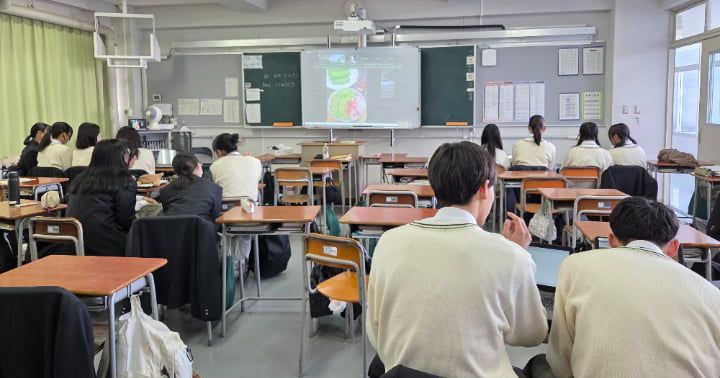
Tokushima, Japan
Tokushima Prefectural Tokushimakita Senior High School
2nd-year International English Course and 2nd-year General Course
1 class each / 80 students in total
2-hour time difference
Jakarta, Indonesia
MA Pembangunan UIN Jakarta
2nd- and 3rd-year high school
1 class each / 62 students in total
- Program
- Tokushima Prefectural Board of Education “Tokushima Glocal Leader Development” Program (徳島と世界をつなぐグローカルリーダー育成事業), Online Exchange Program (FY2025)
- School
- Tokushima Prefectural Tokushimakita Senior High School (2nd-year International English Course and 2nd-year General Course, 1 class each)
- Overseas partner school
- MA Pembangunan UIN Jakarta (South Jakarta, Greater Jakarta, Indonesia / 2nd- and 3rd-year high school, 1 class each)
- Period
- October 2025 – February 2026 (about 5 months, second term to third term)
- Sessions
- 6 per class (40–45 min each) + a connection test in advance
- Students
- 142 in total (80 in Japan / 62 in Indonesia)
- Format
- Online
- Tools
- Zoom, Padlet, Google Slides
Background
The Tokushima Prefectural Board of Education set out the goal of “fostering students who deepen their multicultural understanding and seek to communicate proactively, through an online exchange program with overseas high schools.” We were responsible for everything from selecting the overseas partner school to running the sessions on the day.
The key point of the design was not to make it a one-off exchange. We divided the program into six sessions across the second and third terms, with reflection and preparation for the next session in between, so that students could build their next topics on their previous conversations.
As the partner school, we selected the Japanese-language class at MA Pembangunan UIN Jakarta. Students learning Japanese can speak greetings and simple phrases in Japanese, and many are interested in Japanese culture, so conversations tend to get going from the very first session. In addition, because English is learned as a second language in Indonesia, the dialogue proceeds in English, which is not the native language of either side. This makes it easier for both sides to meet halfway in speed and vocabulary, creating an environment where even students who are unsure of their English can find chances to speak.
What we did
The sessions were held during English class time: 7th period on Tuesdays for the International English Course (15:00–15:40, 40 minutes) and 5th period on Mondays for the General Course (13:10–13:55, 45 minutes). On the Jakarta side, two hours behind, these fell in the 1 p.m. hour and the 11 a.m. hour respectively. The schedule was set to avoid exam periods and school events.
In addition to cross-cultural understanding, a theme common to both classes, we set transportation in Tokushima and Jakarta as the theme for the International English Course, and everyday trends and contemporary culture for the General Course.
-
Day 0
Advance guidance and connection test
We checked how to use Zoom and tested the connection in advance. Students were guided to prepare self-introductions and introductions of their country and school.
-
Day 1
Orientation and cultural introductions
Student representatives from both schools introduced their country, culture, and school life. This was followed by short exchanges in small groups.
-
Day 2
Group exchange 1
Students split into groups of three or four and interacted with two groups from the partner school for 15–20 minutes per group. They posted information about their hobbies and their hometown, Tokushima, on an online board in advance, and introduced it on the day while sharing their screens.
-
Day 3
Group exchange 2
Students interacted again with the same partner groups as on Day 2. By preparing questions based on the previous conversation and posting them in advance, they went deeper instead of ending with first-meeting exchanges.
-
Day 4
Group exchange 3 (themed)
Students interacted with two groups on the theme set for each class. They shared on the board what each had researched about transportation or trends, then discussed it.
-
Day 5
Group exchange 4
Students continued on the same theme with the same partner groups as on Day 4. They brought questions about topics raised in the previous session and sorted out the differences and similarities between the two countries.
-
Day 6
Mini presentations and group photo
Each group summarized and presented what they had learned from the partner school. Finally, everyone took a commemorative photo together.
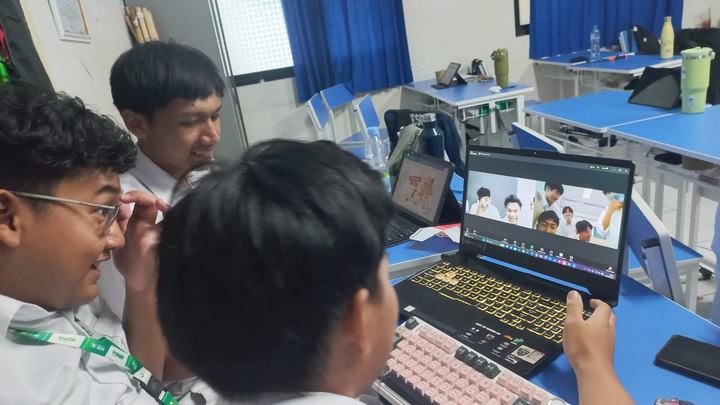
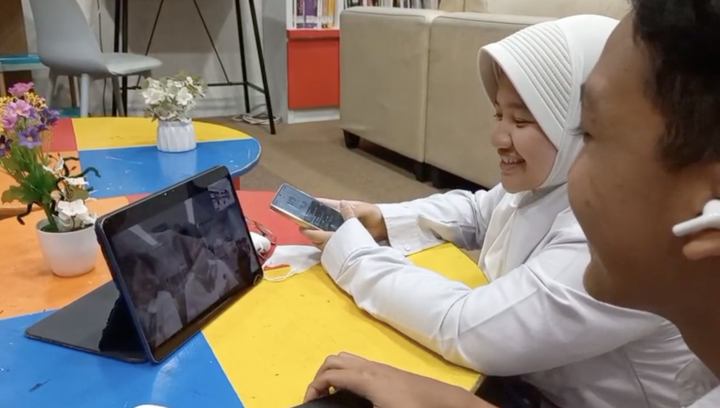
The classroom on the Jakarta side (courtesy of MA Pembangunan UIN Jakarta)
In each session, our language assistants went around the groups and spoke to students who were unsure of their English.
Division of roles with teachers
We handled negotiations with the overseas school and ran the sessions on the day, while we asked the teachers to take care of the classroom and to encourage students.
AirPangaea's responsibilities
- Finding and negotiating with the overseas partner school
- Scheduling based on both schools' academic calendars, events, and exam periods
- Preparing the online board and worksheets
- Providing a format for group assignments
- Facilitating the sessions and providing language support
- Conducting and tallying the survey, and preparing the performance report
What we asked of the teachers
- Securing time for the exchange
- Finalizing group assignments (decided in consultation, based on our format)
- Watching over the classroom and encouraging students
- Reflection after each exchange and preparation for the next session (with materials provided by us)
The teachers are the first to grasp what is happening in the classroom on the day. Because they shared what they noticed on the spot, we were able to adjust the facilitation promptly. For sessions that needed to be rescheduled, we consulted with the teachers and secured make-up class time.
Survey results
After the program, we conducted a survey of the 80 participating students on the Japanese side.
Q: Compared with before this program, please rate how you feel now on a 5-point scale
Total of “Agree” and “Strongly agree” / 76 valid responses
Q: Please rate your satisfaction with the program on a 5-point scale
Total of “Satisfied” and “Very satisfied” / 76 valid responses
Q: Would you like to take part in this program again? (multiple answers allowed)
Selected any of “same partner country,” “different partner country,” or “different theme” / 76 valid responses
At 73%, motivation to learn English was the lowest of the three items. The open-ended responses suggest that while some students became more motivated after encountering the English skills of the partner school's students, others experienced moments when they could not catch what was said and the conversation did not continue, and did not feel a sense of accomplishment. Within six sessions, we did not manage to raise the motivation of every participant.
Students' voices
- I'm really not good at English, and to be honest, I wasn't very enthusiastic about this, but when I used gestures and so on, I was able to get my point across surprisingly well, and with my friends' help I could understand quite a lot of what they said, so it was much more fun than I had imagined.
- Until now I felt that people from other countries were somewhat distant, but I found that they have hobbies like ours and that they are similar to me in some ways.
- Their English was so fluent that I felt we still have a long way to go. I thought I need to improve both my English and my communication skills much more.
Challenges
Audio and connection
In the open-ended responses, some students mentioned that the audio from the partner school was not always easy to catch. The Japanese side improved this by adding equipment partway through; however, depending on the connection, there were also sessions in which some difficulty in hearing remained. From next year onward, we will work on improvements by distributing network routes and arranging classrooms with more space.
Number and length of sessions
Several students said, “It ends just when we're starting to become friends.” We take this as a wish to talk more.
Year 2
In FY2026, we are again in charge of the same Tokushima Prefectural Board of Education program and are preparing for two high school classes in the prefecture (scheduled to start in October 2026).
For those considering a similar initiative
When and on what scale a program can be run depends on your school's class hours and the partner school's academic calendar. To begin, please tell us the number of classes and the timing you have in mind.
Contact us